Chances are you’ve received a notice in the mail about the Council’s proposed Special Rate Variation (SRV).
So what does it all mean? Keeping reading…
Like many councils in NSW, the Northern Beaches Council is facing growing financial pressure.
Why does the Northern Beaches need to consider an SRV?
According to the Council, high inflation, natural disasters, the COVID-19 pandemic, and significant costs shifted to the Council, like the Emergency Services Levy, have placed increasing pressure on the Council’s ability to maintain services and facilities.
A statement on the Council’s website reveals, their budget has been hit with significant costs over recent years, including:
- $15m to cover the impact of natural disasters.
- $41m from COVID-19 pandemic.
- $3m cost shift from the State Government to Council for the Emergency Services Levy.
The Council made savings and found ways to deliver services more efficiently, such as:
- $6m (at amalgamation and ongoing) in decreasing back office operating costs to support increases in some community facing services
- $7.4m saved over the past 5 years through reducing agency personnel costs, bank fees, insurance costs, fleet costs, employee costs and implementing a service review program in 2020 that has led to over 230 service improvements
- $0.5m in annual savings through upgrades to energy efficient sports field lighting and solar panels on Council buildings
- $2.52 million saved since 2021 through a renewable energy contract
- Reducing interest costs through paying down $81m in loans from the former councils.
Despite saving millions, Council says the cost increases have outpaced income from rates at more than double the speed, and Council now have a gap of $24 million every year from inflation alone.
Can Council increase my rates?
Every year, The Independent Pricing and Regulatory Tribunal (IPART) decides how much local councils can raise their rates (the fees property owners pay to councils). This maximum increase is called the ‘rate peg.’
When setting this limit, IPART looks at how much councils’ costs have gone up due to inflation – things like higher fuel prices, electricity bills, and construction costs. This yearly increase helps make sure councils can keep providing their regular services and maintain things like roads and parks.
If councils need to raise rates by more than the allowed amount, they can apply to IPART for special variations to the rate peg.
How much will it cost me?
Council is consulting on four SRV options, here’s a clear breakdown of the proposed rate changes: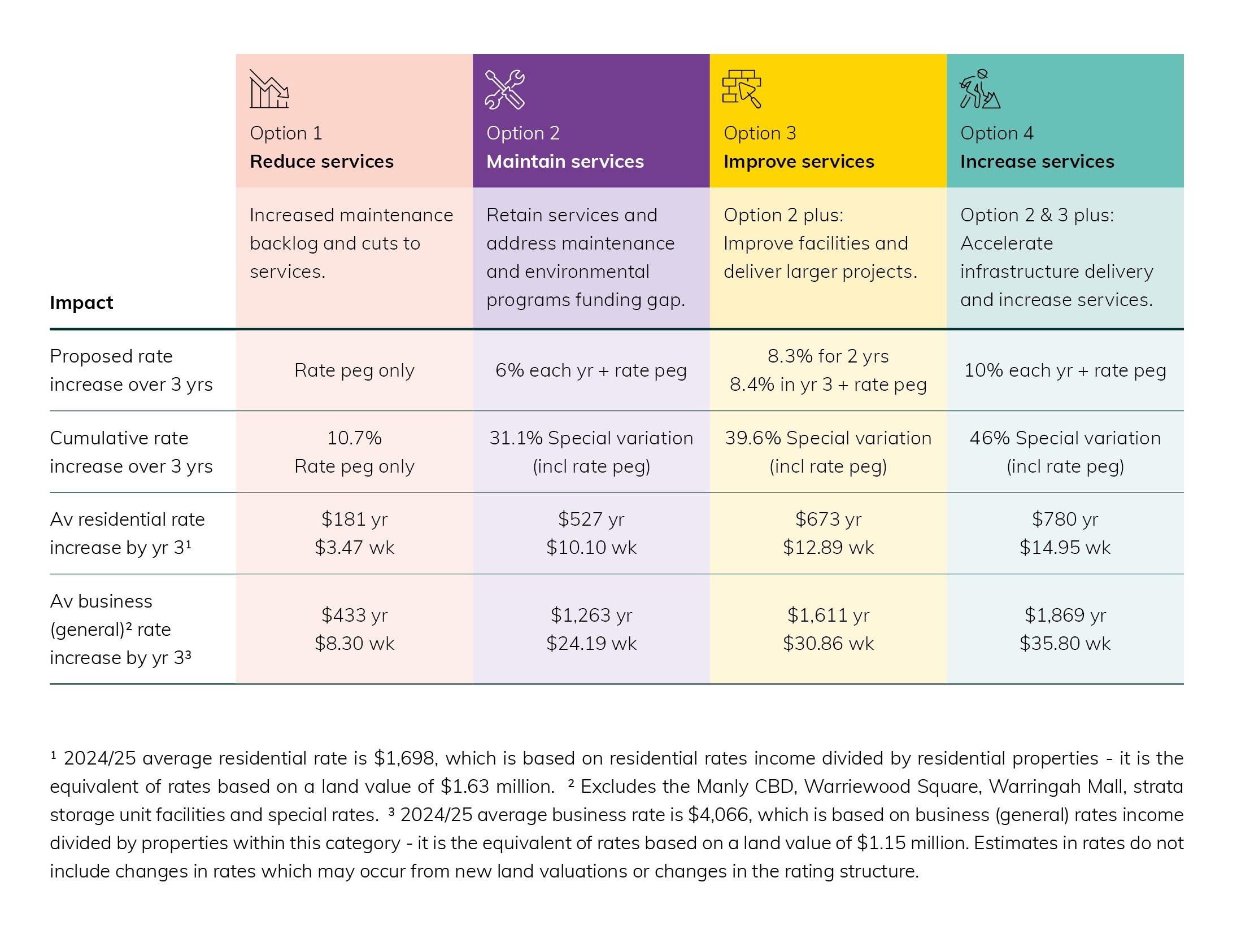
Image: Northern Beaches Council
The council has four choices about what to do with rates starting July 2025:
Choice 1 (Current Path): Just raise rates by 3.8% (the standard amount allowed). This won’t bring in enough money, so the council would need to cut back on community services.
The other three choices involve asking permission to raise rates by more than the standard amount:
Choice 2: Raise rates by an extra 6% each year for three years. This would let the council keep services running as they are now.
Choice 3: Raise rates by an extra 8.3% for two years, then 8.4% in the third year. This would let the council make services a bit better.
Choice 4: Raise rates by an extra 10% each year for three years. This would let the council add more services.
The extra money from these increases would go toward maintaining public facilities, improving infrastructure, running environmental programs, and providing community services.
You can also use the Rates Calculator by entering your address to find out what it will mean for you.
If Council proceeded with Option 1, what services would be cut?
Council says they would need to review current service levels and make some tough decisions which could involve less maintenance, reducing or cutting services to the community and may put at risk the timely renewal of assets which could result in the need to close facilities.
Would a Special Variation be temporary or permanent?
A statement on the Council website confirms the proposed rate change would be permanent, remaining in Council’s rate base on an ongoing basis. From July 2028 onwards, rates would be expected to increase in line with the rate peg.
I can’t afford this right before Christmas!
The good news is this isn’t happening overnight. If the proposed SRV does go ahead, it won’t be passed on until 1 July 2025.
If you are having difficulty in paying your rates, you should contact Council as soon as possible to discuss the options available under Council’s Rates and Annual Charges Hardship Policy.
Concessions are also available to eligible pensioners.
How can I find out more and have my say?
Council invites you to view the options and provide your feedback by:
- completing the submission form, or
- emailing or writing. Include ‘Proposal for a Special Variation to rates’ in the subject line of all email or written feedback.
Submissions close Sunday 12 January 2025
What happens after that?
Once the community consultation period concludes, Council will review the feedback received. A report will then go to Council for their consideration of the feedback. Council will decide whether to proceed with the SRV application.
If Council decides to proceed, the application will be submitted to IPART. IPART will conduct its own consultation, with public submissions likely to be sought, before they make their determination in May-June 2025. If the SRV application is successful, Council will then need to resolve to include the SRV in its rates from 1 July 2025.